



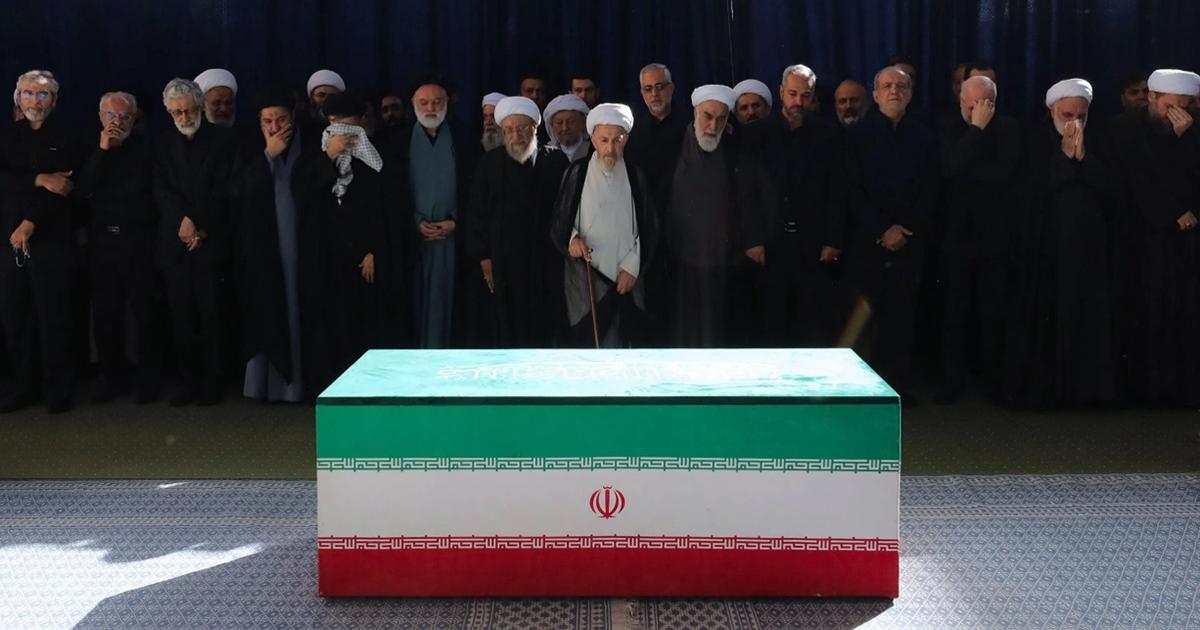
The funeral of Ayatollah Ali Khamenei unfolded as one of the largest and most carefully staged public ceremonies in the history of the Islamic Republic. It was not only a farewell to a religious and political leader, but also a national event designed to show continuity, unity, and reverence for a man who stood at the centre of Iranian power for more than three decades. From Tehran to Qom, from Najaf and Karbala to Mashhad, the funeral route carried both the body of a leader and the memory of an era. Each city added a layer of meaning to the procession, turning the janaza into a public statement about identity, authority, and the future of the state.
Khamenei died at the age of 86 after ruling Iran from 1989, when he succeeded Ayatollah Ruhollah Khomeini, the founder of the Islamic Republic. His leadership lasted nearly 37 years, making him the longest-serving supreme leader in Iran’s modern history. Before reaching that position, he had served as Iran’s president during the 1980s, a period when the country was still defining the shape of its post-revolutionary political order. His later rise to the office of supreme leader placed him above the elected branches of government and gave him final authority over the core direction of the state. Al Jazeera and Arab News both reported that his funeral was scheduled to begin in Tehran on July 4, 2026, and end with burial in Mashhad on July 9.
The timing and structure of the funeral showed careful planning. State media announced that the ceremonies would begin with several days in Tehran before moving to Qom, then to Iraq’s revered cities of Najaf and Karbala, and finally to Mashhad. This route was more than a matter of logistics. Tehran represented the seat of state power, Qom represented clerical authority, Najaf and Karbala carried deep historical and religious weight, and Mashhad was both Khamenei’s hometown and the final resting place he had requested. The result was a funeral journey that linked government, faith, memory, and geography in one long national farewell.
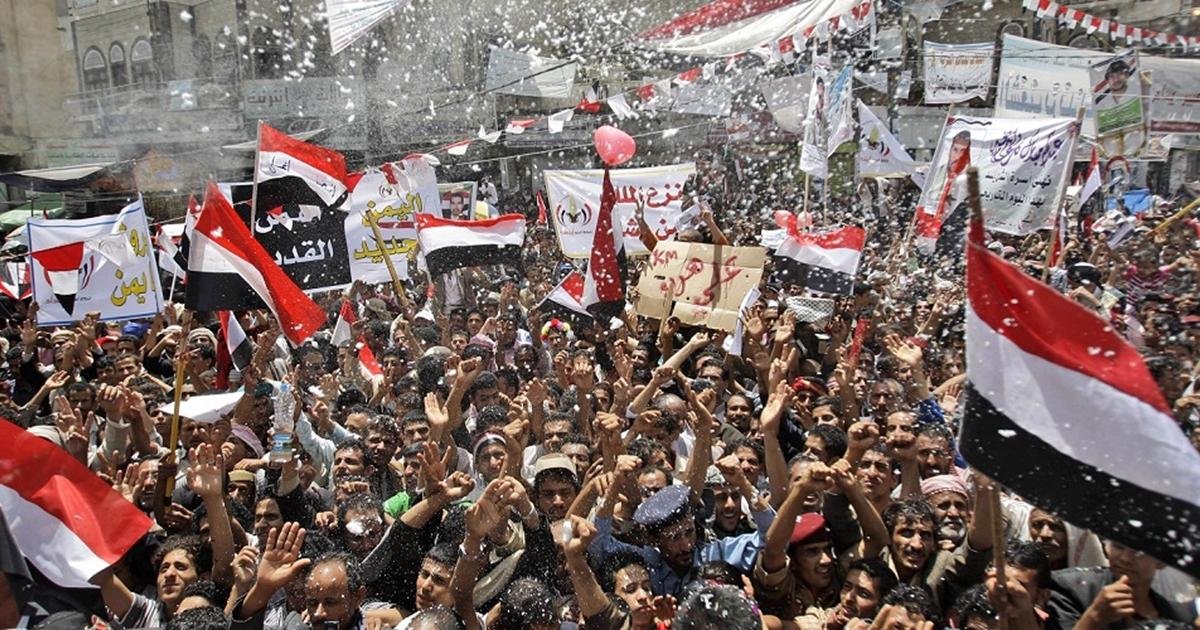
In Tehran, the early ceremonies drew huge crowds. Khamenei’s body lay in state at the Grand Mosalla religious complex before a long procession through the capital. Al Jazeera reported that after two days of public mourning, the coffin began a 12-hour journey through Tehran, accompanied by large crowds. Mourners gathered in major squares and along broad streets, many dressed in black and carrying photographs of the late leader. For many of his supporters, attending the funeral was a way to express loyalty to the political order he had guided for most of their lives.
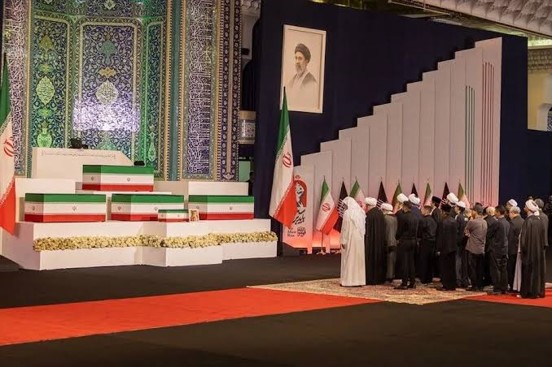
The scale of public mourning became one of the main themes of the funeral. Iranian state television said millions attended the Tehran procession, and officials described it as among the largest public gatherings in the country’s modern history. Al Jazeera also reported that crowds filled major boulevards in Tehran and compared the turnout to the funeral of Ayatollah Khomeini in 1989. Such comparisons were significant. They placed Khamenei’s farewell beside the founding memory of the Islamic Republic and helped present his leadership as part of the same historical line.
The public scenes carried strong emotional force. Mourners threw petals onto the coffins and walked behind vehicles carrying the remains. Some came as families, some as organized groups, and some as individuals who wanted to take part in a moment of national mourning. Emergency services were also present on a large scale. According to Al Jazeera, Iran’s emergency services chief said more than 34,000 participants received medical treatment or emergency assistance, with no fatalities recorded. The figure suggests both the size of the crowds and the physical strain of the long ceremonies.
After Tehran, the procession moved to Qom, one of Iran’s most important religious centres. State television showed a helicopter carrying Khamenei’s body arriving in the city south of Tehran. Qom’s place in the funeral route was central because of its link to clerical learning and religious authority. For a leader who combined political command with religious title, the stop in Qom carried a clear meaning. It connected his leadership to the seminaries and clerical networks that have long shaped the Islamic Republic’s ruling structure.
The ceremonies then extended beyond Iran into Iraq. In Najaf, Iraqi officials and senior politicians received Khamenei’s remains at the airport, with Iranian President Masoud Pezeshkian and Khamenei’s eldest son, Mostafa Hosseini Khamenei, present. The coffin then moved through Najaf toward the shrine of Imam Ali. From there, the route continued to Karbala, another city of major religious importance. The National reported that the Iraq leg was planned for Najaf and Karbala, while the Baghdad stop was removed from the schedule because of limited time.
The Iraq processions added a wider regional dimension to the funeral without changing its main purpose as a national farewell. Najaf and Karbala are closely tied to Shia religious memory, and their inclusion gave the funeral a larger symbolic reach. Al Jazeera reported that hundreds of thousands gathered in Najaf, while the Popular Mobilisation Forces said more than 2.3 million people took part there. Such figures are difficult to assess independently, but the reports leave little doubt that the turnout was vast. The presence of Iranian and Iraqi officials also showed that Khamenei’s public image extended beyond Iran’s borders.
The final stage was Mashhad, where Khamenei was to be buried near the shrine of Imam Reza. This location carried personal, political, and religious meaning. It was his hometown, and officials said he had requested burial there. Al Jazeera reported that the burial ceremony in Mashhad was scheduled for 2:30pm local time on July 9, although larger-than-expected crowds had delayed earlier processions. Mashhad therefore served as the closing point of a journey that had passed through the state capital, Iran’s clerical centre, Iraq’s sacred cities, and finally the city most closely tied to Khamenei’s own life.
Khamenei’s life was deeply tied to the formation and survival of the Islamic Republic. As supreme leader, he did not govern like a president or prime minister. His role was broader and more enduring. He oversaw the direction of state institutions, influenced major appointments, guided security and foreign policy, and stood as the final authority in the political system. Presidents came and went during his rule, but Khamenei remained. This gave him a unique place in Iranian politics: he was not only a leader of government, but the central figure around whom power was arranged.
His leadership also shaped the relationship between religious authority and state authority. The office of the supreme leader sits above Iran’s elected institutions, but it depends on more than formal law. It also relies on networks of clerics, security bodies, loyal political groups, state media, and public ritual. Khamenei understood the value of these networks and used them to preserve continuity. The funeral reflected that same structure. It brought together clerics, state officials, security figures, foreign guests, ordinary citizens, and organized mourners in one public act of remembrance.
The political symbolism of the funeral was therefore clear. It showed that the system wanted to present itself as steady after the death of its most important leader. The attendance of senior officials helped convey institutional order. President Pezeshkian appeared among the mourners in Tehran, while other senior figures from the judiciary, foreign ministry, security bodies, and military-linked institutions were also seen at the ceremonies. State media framed the processions as proof of unity and loyalty. Even the careful movement of the coffin from city to city served a political purpose: it turned grief into a visible map of authority.
At the same time, Khamenei’s legacy cannot be reduced to the size of the crowds. He leaves behind a system that he helped shape over many years. Supporters view him as a guardian of the Islamic Republic who kept the state intact through long periods of pressure, economic difficulty, and political strain. To them, his long rule represented discipline, independence, and a steady hand. Many mourners at the funeral appeared to treat his passing not only as the death of a leader, but as the closing of a chapter in their own political lives.
For others, his legacy is more contested. His rule was long, centralized, and deeply influential. Over nearly four decades, Iran changed in population, culture, economy, and public expectations. Young Iranians grew up under a system in which Khamenei’s voice was always present, even when he was not seen daily. His decisions affected elections, social policy, media control, foreign relations, and the boundaries of public debate. Any fair account of his life must therefore recognize both his authority and the debates that surrounded it.
The funeral also raised questions about memory. State funerals often do more than bury leaders. They organize public feeling and decide which parts of a leader’s life receive the brightest light. In Khamenei’s case, the ceremonies stressed service, sacrifice, religious identity, national endurance, and continuity. The long route and mass gatherings presented him as a figure of national scale, not only a political officeholder. The choice of Mashhad as his burial place added a final note of rootedness, linking the highest office in the state back to the city of his birth.
The role of family was another notable part of the ceremonies. Some of Khamenei’s sons appeared publicly, while reports noted the absence of Mojtaba Khamenei, his successor, from the processions. Without moving into speculation, that absence added to the sense that the funeral was also a moment of transition. A system built around one dominant leader had to show that it could continue after him. In that sense, the janaza was both an ending and a public rehearsal of the next phase.
The overall legacy of Ayatollah Ali Khamenei will be discussed for many years. He was a cleric, a former president, and the supreme leader who gave Iran’s post-revolutionary system much of its long-term shape. His funeral showed the scale of the state he led and the loyalty he still commanded among large sections of society. It also showed how public mourning can become a language of politics, especially when a leader has occupied the centre of national life for so long. From Tehran’s crowded avenues to Mashhad’s final rites, the farewell to Khamenei was not simply a burial. It was the public closing of an age in Iranian politics.
- Business News 116
- Country News 16
- Feature News 67
- International News 241
- Interview News 36
- National News 37