



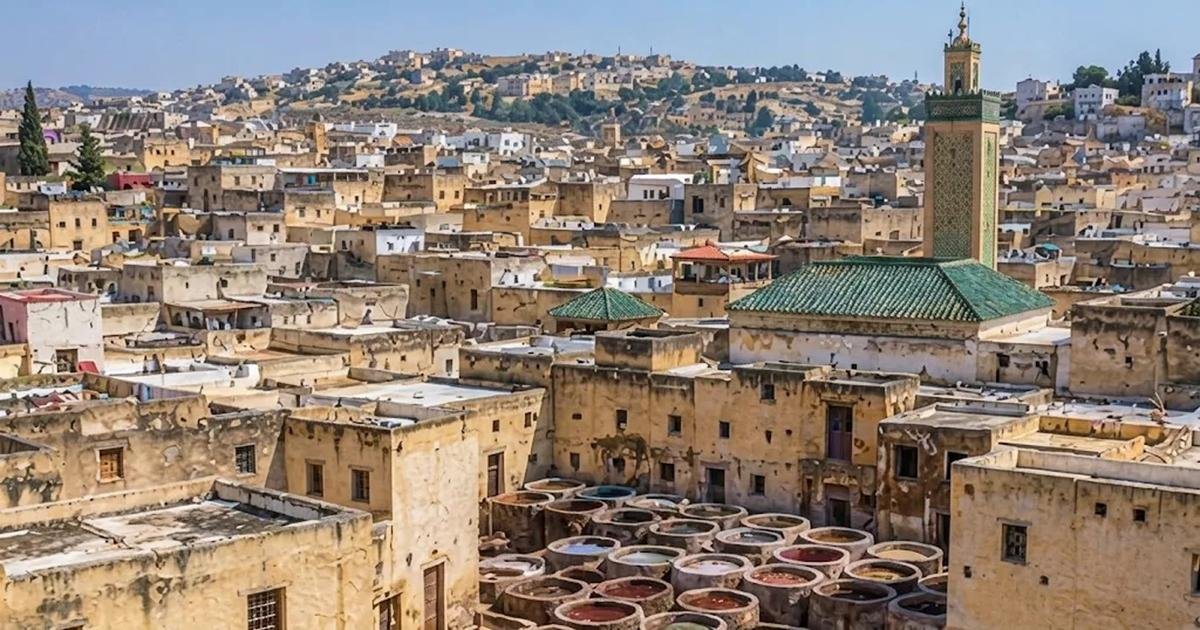
Morocco celebrates Independence Day today, 18 November, recalling the address given by Mohammed V after his return from exile in 1955. The speech came as the country moved towards the end of the protectorate, and France formally recognised Moroccan independence in March 1956. The November anniversary gives Moroccans a chance to remember that period and to consider the country that has developed since. Much of its character is visible in the places where people work, buy their food and learn a trade.
Fez offers a particularly good place to start. In the old city, narrow lanes lead past homes, mosques, markets and workshops that serve customers from the surrounding neighbourhoods. Workers who cut pieces of coloured tile for zellige spend years learning how to shape and fit them into a pattern. From a distance the finished surface looks continuous, but up close each small piece shows the precision required to cover a courtyard wall or a fountain.
Other cities tell different parts of Morocco’s story. Rabat, the capital, faces the Atlantic and includes both historic districts and areas developed in the twentieth century. Casablanca is a commercial centre whose streets show the influence of different periods of building. Tangier looks towards the Strait of Gibraltar, and its location helps explain the long history of movement between northern Morocco and the other side of the Mediterranean.
Away from the coast, the Atlas Mountains shape rainfall, routes and agriculture. Mountain communities grow fruit and tend livestock where conditions allow, and settlements in drier areas depend on careful management of water. The route from a mountain village to a city market may carry apples, nuts, wool or other products with a clear connection to the place they come from. What a shopper sees on a stall reflects a whole season of work elsewhere.
Arabic and Amazigh are Morocco’s official languages, and the Arabic spoken in everyday conversation, often called Darija, has expressions that vary from one part of the country to another. Amazigh varieties have their own regional homes and oral traditions. A visitor may also hear French or Spanish, depending on the setting. For young people who move from home to university or work, this variety can mean learning when and how to switch between several ways of speaking.
Music offers a further introduction. Gnawa musicians are known for performances in which the low sound of the guembri, a stringed instrument, is accompanied by singing and metal castanets. UNESCO lists Gnawa as intangible cultural heritage, recognising the knowledge that lies behind the music and its social uses. Concerts introduce it to new audiences, while learning from experienced musicians helps performers understand the traditions from which the music comes.
At home, couscous can be a family meal that takes time to prepare and is served from a shared dish. Regional recipes make use of different vegetables, spices and meats, and the cook may adjust the meal to suit the season. The knowledge and practices connected to couscous are recognised by UNESCO through a joint nomination by Morocco and three neighbouring countries. It is an example of a food that can be recognisably local while belonging to a wider North African tradition.
Morocco’s economy includes export industries such as vehicle manufacturing, while farming, tourism and small businesses remain important to communities across the country. Ports and roads help connect producers to customers overseas, and technical training helps prepare students for work in factories and services. The skills used in an old workshop and those learned on a modern production line serve different markets, but both depend on people who can teach their work to others. That makes training a practical part of the story of national development.
The kingdom’s membership in the Organisation of Islamic Cooperation brings another setting for exchanges in areas such as education, trade and heritage. For Morocco, whose towns and ports have long received people from elsewhere, these contacts are part of an established outward-looking habit. Universities, cultural organisations and businesses give that habit a form that people can take part in directly. The relationship between local knowledge and wider exchange continues to shape what the country makes and shares.
As Morocco marks Independence Day today, the 1955 address remains the reason for the date. The anniversary also makes room for the people whose work gives the country its present character. Among them are the tile worker teaching an apprentice, the farmer preparing produce for market and the student learning to work with new equipment. Their work takes place in very different surroundings, yet each depends on knowledge built over time and passed on with care.
- Business News 119
- Country News 16
- Feature News 67
- International News 256
- Interview News 36
- National News 42